
Pianos, Portraiture and a PhD: Painting our Principal
By Dr Anna Drummond, Heritage Curator and Gallery Manager
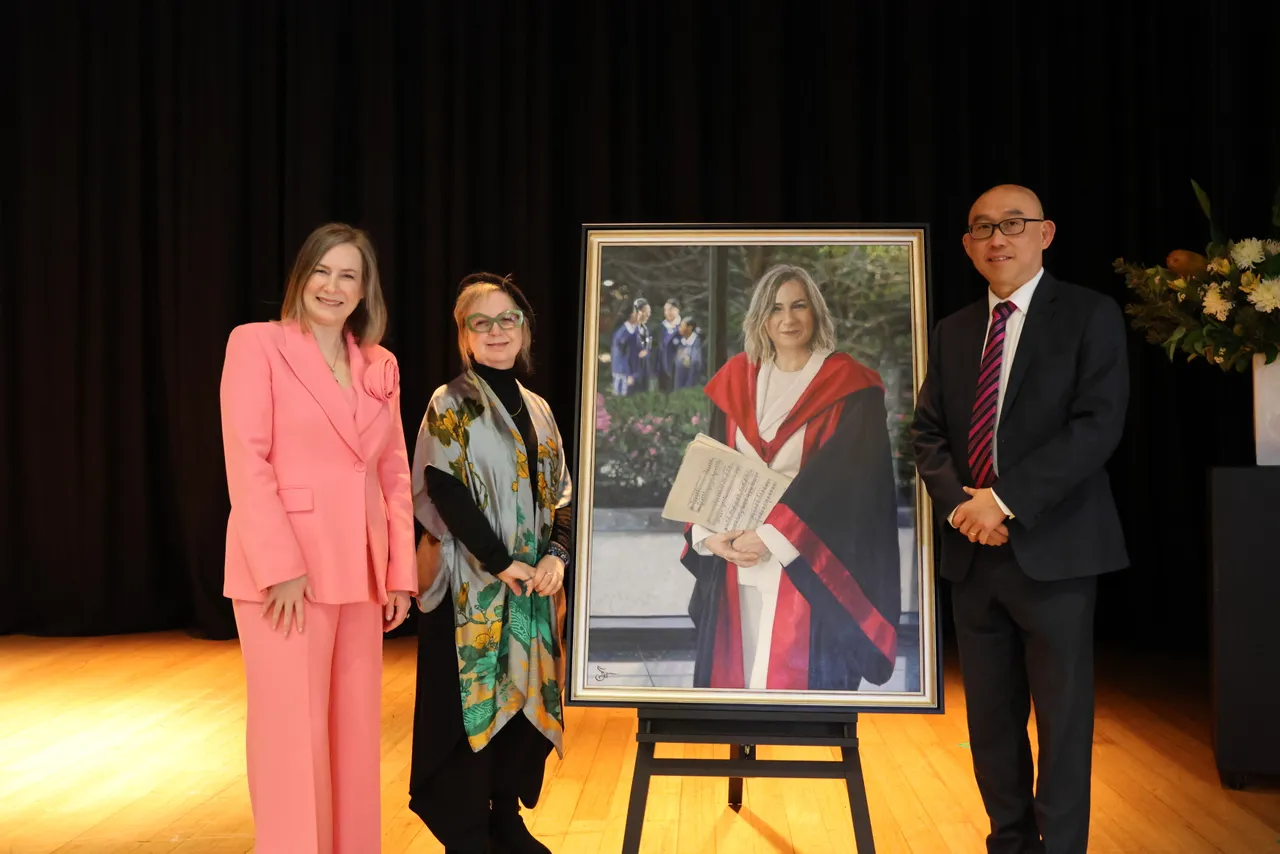
One sits on a striped couch, the other in front of a fresco of angels. Another has a vase of bluebells and a landline phone. These are PLC’s principals as depicted in their portraits, some of which have gazed benevolently from the walls of Wyselaskie Hall for over a century. As well as a tribute to each of our past leaders and their service to our school, our portraits are notable pieces of art in their own right, created by some of Australia’s most important painters. For all these reasons, it was a significant moment recently when, for only the thirteenth time in our history, we unveiled a new portrait. At a special assembly early in Term 4, staff and students were delighted to catch a first glimpse of the new addition to this collection and hear about its creation.
At the Assembly, Art Captain Shenny shared some of the fascinating history of PLC’s portraits and Dr Burgess reflected on the experience of being painted. Award-winning artist Jaq Grantford, who painted the portrait, spoke about the process of capturing Dr Burgess on canvas, and her personal link to our school as the daughter of a former PLC music teacher. Jaq explained that for her ‘the most important thing in a portrait is capturing something of the essence of the person.’ In Dr Burgess’s case, she says:
I was really struck by how kind Emma seemed and how genuinely interested she was in the students. She was very keen for them to be part of the portrait, which reflected how important they were to her role at the school…Above all, I wanted the portrait to convey Emma as the kind, thoughtful and intelligent person that she is.
Just as the artist had a vision of what she wanted to convey in the portrait, Dr Burgess wanted her priorities and values to be evident in the picture too. For this reason, the painting contains a series of carefully chosen symbols about her and her leadership. As a nod to women achieving the highest levels of learning, scholarship and leadership, she chose to wear her PhD gown and colours. To convey that students are always at the heart and centre of everything she does, she asked for a group of students to be included. The sheet music she holds in her hands is a reference to her deep love of music as a diploma-qualified pianist. The PLC gardens in the background symbolise Dr Burgess being grounded by the PLC landscape, but also her goal of cultivating the conditions for others to flourish and shape a fulfilling life of purpose and meaning. Having worked to make this vision a reality, the artist hopes that the painting ‘represents Dr Burgess as she is, while also telling something about who she is and what she values.’
A century of fascinating faces
Dr Burgess’s portrait is the latest chapter in a history of portraits at PLC that goes back over a century. Our school began commissioning portraits in the early twentieth century, at a time when it was common for universities, courts, schools, cultural, medical, religious and corporate institutions to commemorate their leaders’ contributions; a tradition that continues today in many of Australia’s oldest institutions. At PLC, this began in 1911 when current and former students of retiring third principal Samuel McLaren (Principal 1890-1911) decided to honour his decades of service to our school by commissioning his portrait. The painting took several full days to execute, during which time Mr McLaren had to be present and remain standing perfectly still. It is perhaps no surprise that viewers thought he looked unduly serious in the picture, although he himself approved and declared that the artist had captured something of his solemn personality.
After the success of Samuel McLaren’s portrait, PLC decided to commission paintings of its two previous principals. The first, George Tait, had passed away so artist June Hobart likely worked from a photograph. The other principal, Andrew Harper, was painted by one of Australia’s most significant artists, Violet Teague, an Old Collegian who was at PLC in the 1880s. One of the first ever Australian women to become a professional painter, Violet Teague achieved international fame and was celebrated in Paris and beyond. Having been a student at PLC during Dr Harper’s time, she portrayed the former principal in the posture he used when delivering morning prayers, and in the background recreated a famous fresco in Florence that symbolised a speech he once gave. This painting, like others in our collection, is not just an important commemoration of a PLC principal but a significant work of art in its own right.
Violet Teague is not the only significant artist to have painted a portrait for PLC. In fact, some of Australia’s most important portrait artists have painted for us. Almost all have won major prizes and have been awarded important commissions to paint prominent figures such as Prime Ministers, royalty, global celebrities and even the Pope.
Just as Jaq Grantford has done with Dr Burgess, their portraits capture not only what our principals look like but suggest something of each leader’s personality and priorities as well, often encoded in cryptic clues within the painting. The portrait of William Mackay (Principal 1986-97), for example, includes a bunch of bluebells symbolising Scotland, the country of his birth and upbringing, where he has lived since retiring. In the background of his painting is a landline telephone, which may not be symbolic but certainly places him in time!
While Dr Burgess’s portrait contains no technology, it celebrates the priorities and qualities of our principal and is a fitting addition to this important collection.

Presbyterian Ladies’ College acknowledges the Wurundjeri, Woiwurrung and Boonwurrung people of the Kulin Nation as the Traditional Custodians, by God’s gracious providence, of the land on which our school stands.